
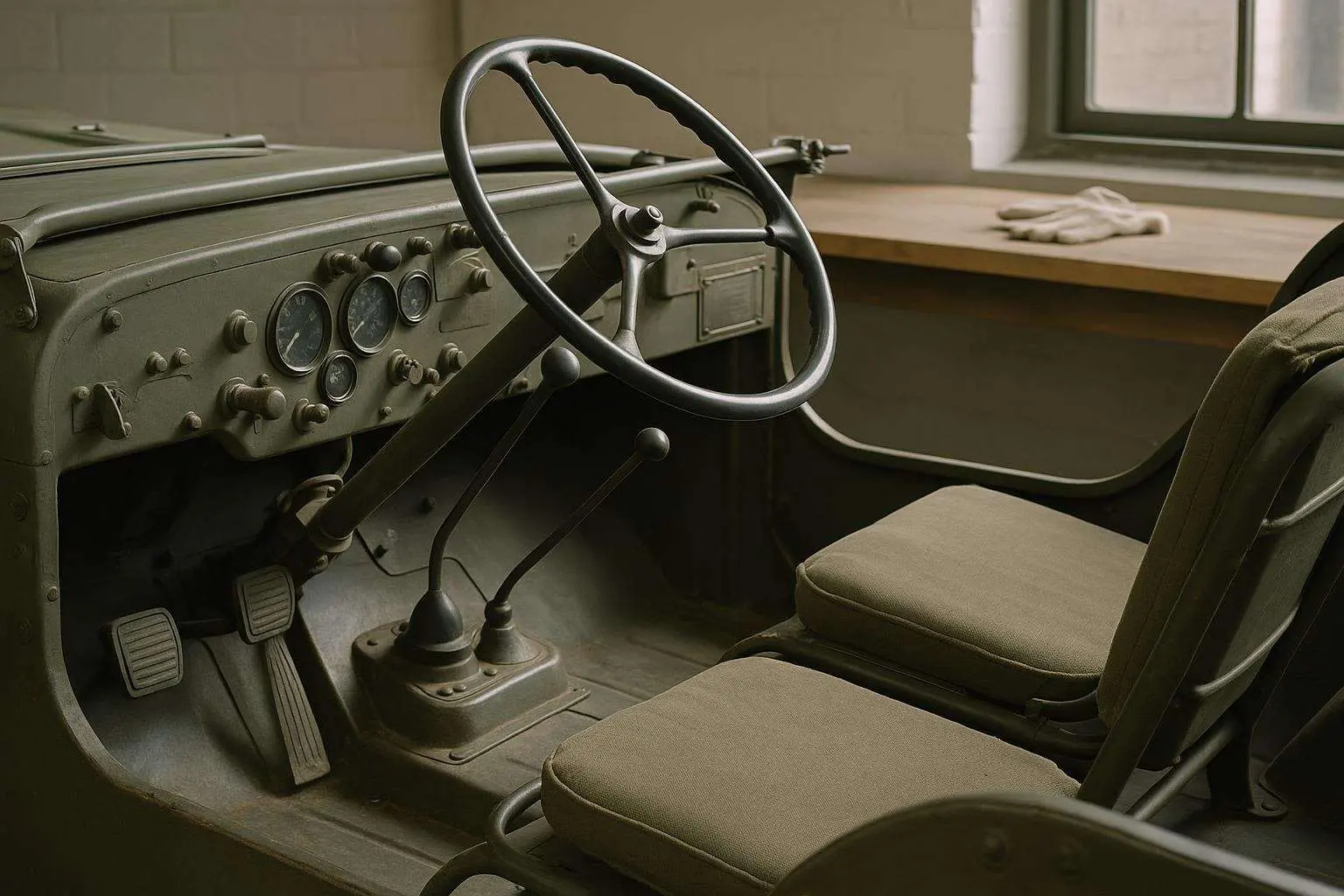
Begin with a basic question: are you examining a wartime object, or a later reconstruction? That distinction matters because the familiar story of the jeep is often repeated with more confidence than the surviving evidence permits.
The common claim is simple: Willys invented the jeep, built every wartime example and sent an essentially unchanged vehicle into service. It makes a tidy caption, but it is wrong in several useful ways. The record becomes clearer when a restored vehicle, museum label or loose component is treated as evidence to test rather than proof of a complete story.
The familiar story leaves out the competition
The American military jeep emerged from a competitive development process, not from one company's finished design. The American Bantam Car Company produced an early prototype for the Army's light reconnaissance requirement. Willys-Overland and Ford then became central to production, with both manufacturers building vehicles to military requirements and shared specifications.
The Willys MB is therefore important to jeep history, but it is not a synonym for every wartime jeep. Ford's GPW was closely related and used many interchangeable parts, yet its factory practices, markings and some component details can help identify its origin. A vehicle may look like a Willys while carrying evidence of Ford production, postwar replacement or decades of civilian use.
That does not make the object less valuable. It makes the question more precise. Rather than asking whether a jeep is simply "original," ask which parts, markings and layers of repair belong to which period.
Read the vehicle as a layered document
A surviving vehicle is not a frozen moment from the 1940s. It records manufacture, military service, depot work, civilian ownership, rebuilding and restoration. Its body panels may come from one period, its engine from another and its paint from a later interpretation of wartime appearance.
Small details can carry disproportionate weight: a manufacturer's stamp, casting mark, serial-number plate, weld pattern or surviving field modification. Each may support one history while contradicting another, but none should be treated as decisive alone. Parts were replaced, markings repainted and vehicles rebuilt from assemblies that had already served elsewhere.
This is where material culture differs from nostalgia. Scratches, mismatched fasteners and repair evidence are not automatically defects to erase. They may show how an army kept equipment operating under pressure, or how a civilian owner adapted surplus equipment to roads, farms and workshops after the war.
Provenance is stronger when it has friction
Vehicle provenance means more than a compelling family story or a photograph of a similar-looking jeep. It is the chain of evidence connecting an object to its claimed manufacture, use and later custody. That chain may be incomplete, but its gaps should remain visible.
When assessing a claim about a military vehicle or artifact, ask:
– Does the identification agree with the serial numbers, manufacturer marks and construction details?
– Are photographs, documents or ownership records tied to this exact object rather than to the model generally?
– Which components are documented replacements, and which are merely assumed to be original?
– Does the proposed timeline explain the visible repairs, paint layers and modifications?
A good answer may be qualified: "built as a Ford GPW, later rebuilt with Willys parts, restored using period-style components." That is less dramatic than "untouched wartime jeep," but it tells the reader far more. Honest uncertainty is part of provenance, not an embarrassment to conceal.
Records also need context. A vehicle in a wartime photograph may not be identifiable from its grille alone. A unit marking can be repainted, transferred or misread. A date on a registration document may describe civilian ownership rather than military manufacture. Evidence becomes persuasive when several independent clues point in the same direction.
Restoration can preserve history or flatten it
Jeep restoration sits between conservation and interpretation. One approach aims to return a vehicle to a particular military appearance; another preserves layers of use, including worn paint, nonstandard repairs and later modifications. Neither is automatically correct. The choice should depend on the object's documented history and the purpose of displaying it.
Replacing every irregular part with a visually perfect substitute may create a convincing period image while destroying useful evidence. Conversely, leaving a vehicle unstable or exposing fragile original material without protection is not preservation. Sound work begins by recording what exists: photographs, measurements, markings, paint layers and component relationships before disassembly or refinishing.
A responsible display tells visitors what has changed. Reproduction canvas, replacement wiring, rebuilt engines and recreated markings should be identified when they affect interpretation. That candor strengthens the object by showing how museums, collectors and repairers know what they think they know.
The same principle applies to loose military artifacts. A tool, jerry can, data plate or wheel may have greater historical value when its uncertain connection is explained than when it is placed beside a vehicle with an implied but unsupported story.
What survives after the myth is removed
The myth audit does not leave us with nothing. It leaves a stronger account: the jeep was the product of American industrial cooperation and military standardization, built by more than one manufacturer and repeatedly altered by the people who depended on it. The Willys MB remains a major reference point, but its significance grows when placed beside the Ford GPW, earlier development work and the long afterlife of surplus vehicles.
That wider view changes how public history works. A museum label, restoration file or club conversation can move beyond model names and visual authenticity to explain labor, supply, repair and reuse. Military artifacts are not valuable only because they appear unchanged. They matter because they preserve decisions made by factories, mechanics, soldiers, owners and conservators.
For anyone studying a jeep, the practical lesson is modest: slow down before accepting the neatest story. Compare marks with records, distinguish original material from later work and preserve uncertainty where the evidence cannot decide. Once the exaggeration is removed, what remains is more complicated than legend-and much closer to history.